Ebike To Work Project - Inspiring News from The U.K.

To aid young people training or starting their first jobs in areas surrounding Worcester, who may lack a car or have limited public transport links, The Malvern Hills District Council (MHDC) has launched an Ebike To Work program.

Worcester is a region south east of Birmingham.

Participants must be aged 16 years or over, live or work/train in the Malvern Hills District and are engaged in new work, or a training or college course.

In conversation with The Malvern Observer, Robin Coates, Co-founder of Malvern Hills Community Car Club, said: “We have been helping residents in the Malvern area since 2009 to see just how wonderful Ebikes are for making everyday trips easy, pleasant and healthy. We have done this by providing good e-bikes for short term loans. With this grant we can now start to help people use ebikes to get to work and they can hire an ebike for longer periods.”

For the past 12 years, the MHDC has had a two-week ebike loan scheme (yes, 12…that is impressive!) Now, a larger fleet of e-bikes is on offer for those who qualify for a subsidized fee of £15-a-week.

Coun. Daniel Walton, Malvern Hills District Council’s Portfolio Holder for Economic Development and Tourism, said: “There are many well-known benefits to e-bikes, from environmental to health, but for us, this is a great opportunity to work with Malvern Hills Car Clubs and offer an affordable transport solution to help people access work and training. As well as improving transport options for people in the district it also supports our Destination Zero commitment to cut carbon emissions and encourage the use of more sustainable modes of transport.”

Regions across Canada, take note!  This is inspirational!

Zygg Subscription Ebikes Vancouver - Getting Ready To Launch

Zygg is busily preparing to launch in their second Canadian City in March. Check out the Zygg Vancouver page for details on the three styles of ebikes on offer and how to get signed up. Complete the introduction form and you will get a discount when we launch!

Here are the three models to choose from:

  1. Model QX for personal use - has a range of 60-80km, 8 gears, integrated lights, a removable battery and 5 levels of power assist.

  2. Model A for personal use - has a range of 100-150 km, 5 gears, integrated lights, a removable battery, 3 levels of power assist, and weighs 59 lbs.

  3. Model R for delivery riders - has a range of 70 - 90 km, 9 gears, integrated lights, a removable battery, 5 levels of power assist, and weighs just 49 lbs.

As a backgrounder, we would like to showcase some key Vancouver Cycling resources and highlights:

FANTASTIC CYCLING INFRASTRUCTURE

50% of Vancouveries cycle regularly, up 21% from 2006-2016
— City of Vancouver

In the past 15 years, Vancouver has developed a multi-faceted cycling culture -  complete with pleasure cyclists, work / school bike-commuters and a very visible community of bike, ebike & cargo-bike delivery riders. The most recent Vancouver Cycling Report Card, 2017 reveals that 50% of citizens cycle regularly, up 21% from 2006-2016. From 2011-2016, Vancouverites who cycle to work increased by 41%, more than any other Canadian city! The report’s statistics note that cycling for both errands/social reasons, as well as cycling to work, is most common close to Downtown, with an average daily ride for “personal” trips being 4.8 km (19 mins), and 6km (24 min) for those biking to work. With more than 450 kilometres of bike routes in Vancouver, it’s no wonder that cycling is the city’s fastest growing travel method. In 2017 alone, 550,000 trips were made by bike, for a total of 1.5 million km traveled. The most popular & longest route is the impressive 31.5 km along the Vancouver Seawall.

Find a cycling route: The City of Vancouver Cycling Routes, Maps, updated for 2022.

With the new addition of dedicated bike lanes going out to & around the suburbs, like Surrey & Richmond, B.C., and, with more people embracing the wonders of e-bikes, the popularity of cycling has expanded dramatically, throughout the region.

BIKE RENTAL / BIKE SHARE

Zygg, with its subscription ebikes is pleased to join an awesome community of Vancouver bike share / bike rental programs:

  • MOBI

Courtesy of Mobi

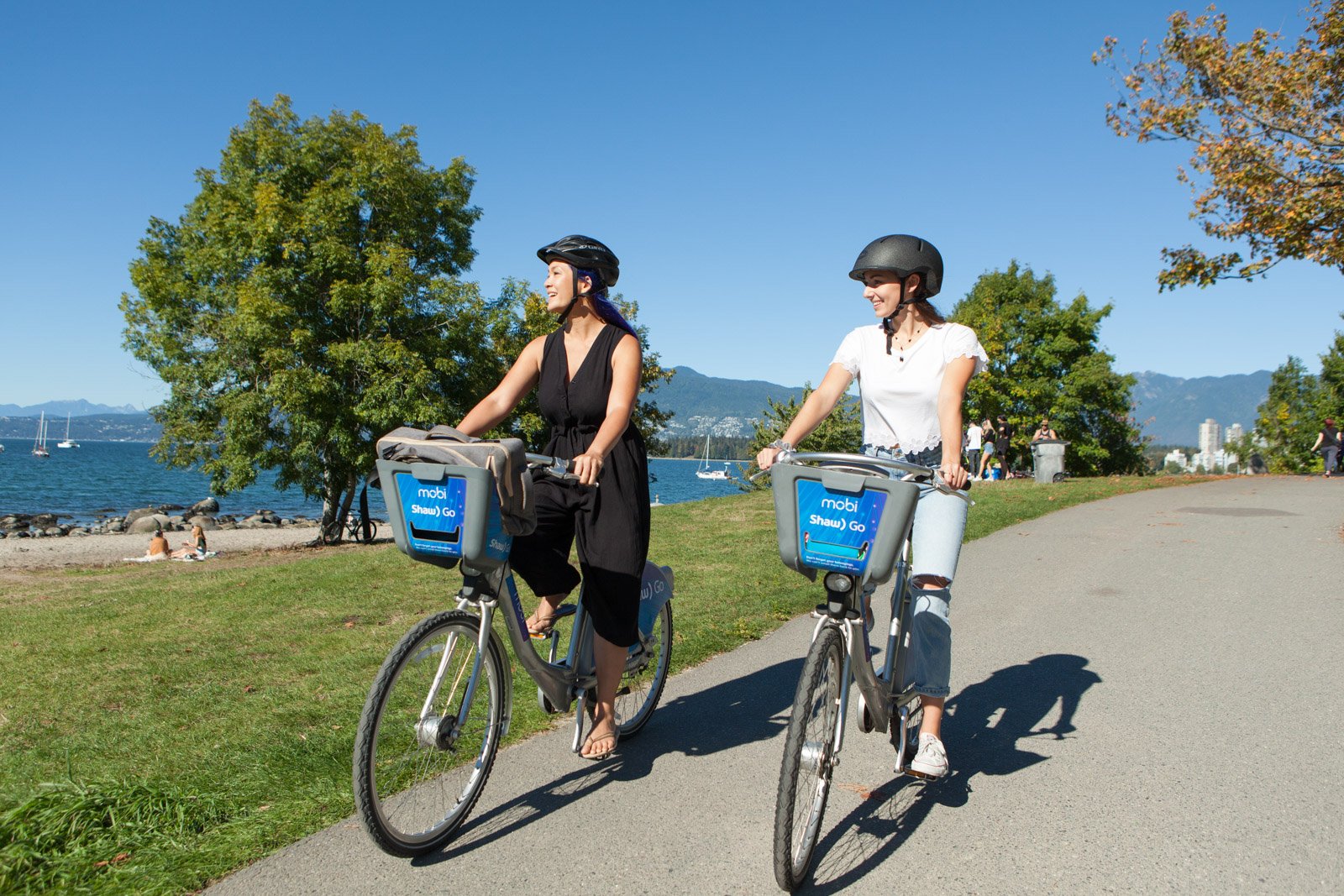
Vancouver’s citywide bikeshare, Mobi, launched in 2016 with 6,400 subscribers, 250 bikes & 23 bikes stations. By 2017, their numbers grew to 1,250 bikes at 125 stations with 650,00 trips covering over 2 million km. For all you ‘micro-mobility-geeks’, you will find it cool that 75% of Mobi users combine walking & transit into their routine, as well.

  • VAN CITY BIKES

Van City Bikes is a bike shop & rental company who also conducts bike tours throughout Vancouver. Their locations have excellent access to explore Stanley Park and the Vancouver Sea Wall

In tandem with Zygg’s upcoming launch in Vancouver, you can book test-rides of Zygg ebikes at Van City Bikes Waterfront Station location, on Granville Island. More details will be posted soon!

A VIBRANT CYCLING COMMUNITY:

Vancouver’s Bike Hub is an excellent resource for safe-cycling tips, fun cycling events & legal advice. They are hosting The Bike Awards (The Best In Vancouver Cycling, virtual event) on February 24, 2022. They publish an amazing Vancouver Cycling Handbook, which is a must read for the cycling enthusiast and newcomers to biking.

Did you know that:

Wearing an approved bicycle helmet that meets safety standards is the law in B.C. and you could be fined for not wearing one. Focus on how it fits: the helmet should sit level on your head (not tilted back) with the front edge one inch or less above your eyebrows to protect your forehead and should be snug so it can't roll off of your head when the chin strap is secured. Also, you need a front, white light and red, rear reflector (*all Zygg ebikes have these) There is a Fine of $29 for no helmet and riding after dark without lights ($109). 


You will be able to purchase a top-notch helmet from Zygg with your Ebike Subscription.

Are We All Ready To Copenhagenize?

Welcome News from the World Of Cycling

Back in 2015, Copenhagen took the lead from Amsterdam as “the world’s most bike-friendly city”. 62% of trips to school or work by citizens were by bike, for a collective 1.44 million km traveled a day. There were four bicycle bridges completed or under construction in the last few years, adding to the 12 bike / pedestrian bridges built in just the last decade. 42,000 Copenhageners cross the Queen Louises Bridge via bike every weekday, and even more ride the 167 km of regional, cycling highways. 

Copenhagen was not always this way.

It took political will and major incentives over several decades to create a culture and incremental expansion of new cycling infrastructure to support and sustain this global model. For the past several years, the phrase “Copenhagenize” has been ubiquitous when speaking about transitioning cities to embrace the social, economic, environmental, and health benefits that come from urban cycling. There is even a “Copenhagenize Index” , established in 2011, which measures a city’s “bike friendly” status through three categories :

  1. Culture 

  2. Infrastructure 

  3. Ambition 

For example, the index measures how many trips are made on a bike, how many kilometres of roads, pathways, lanes and bridges are dedicated to safe use by cyclists and pedestrians, and how much secure bike-parking is provided. Check out how the scores are calculated, under methodology. The Index’s motto is: “With rising urbanisation, our cities need modern, mobility solutions and the bicycle proves time and again that it can offer results.” 

Canadian-Danish urbanist / designer Mikael Colville-Andersen cleverly stamped his website with the phrase. His scheduled scheme for 7,550 bike parking spots behind Copenhagen Central Train Station (which includes 640 secure spots, 30 for cargo-bikes, with a bike shop and lots of public space) is emblematic of the movement.

Copenhagen Index

The last published Copenhagen Index with statistics from 2019, listed Copenhagen in the top spot, with a score of 90.2%. Amsterdam and Utrecht were in a close race for second, at 89.3% and 88.4%, respectively. Zygg is delighted to report that Canada has two cities in the Top 20 worldwide, with Montreal and Vancouver in a tie for the number 18th spot (53.6%). See how the top 20 performed, via the link, above.

During the past two years, as a response to the pandemic, in tandem with a desire to create a more carbon-neutral urban form, there has been an exponential shift towards putting cycling, walking and public transit first, ahead of the car. Many cities have made huge strides in these areas. Montreal and Vancouver are in good company.

Montreal & Vancouver - frontrunners in Canadian cycling infrastructure

Montreal was one of the first cities in North America to establish biking infrastructure - as early as the 1980s - and increased their cycling culture between 2007-2009 with a larger, extensive network of bike lanes and the bike-share BIXI. Recently, the city was quick to build 112 km of Safe Active Lanesfor cyclists and pedestrians in the summer of 2020, as part of a total 327km of new biking infrastructure that same year. Montreal even has its own “Copenhagenize Office” which hosted the first-ever North American Master Class for in-depth analysis and workshopping into cycling across the continent, in the autumn of 2021. Although Montreal is a leading cycling-city, the Index denotes areas for improvement: including, a need for more safe, separated lanes (not just paint which wears off), greater winter maintenance and better multi-modal connections with public transit.

The Index praises Vancouver not only for new lanes on major downtown streets, but also over key bridges (an initiative which took strategic lobbying and engineering) creating an expansion of routes to the suburbs with paths through surrounding regions like Surrey and Richmond. Vancouver, formerly a place for exploration and “leisure-cycling”, has now converted to a bike-commuting culture. Cargo bikes and e-bikes for delivery are also very visible on the streets of Vancouver, which Zygg will profile in a future Blog post.

Paris & Milan taking big steps towards being the “most bike friendly city”

As we await the next Index, revealing who will take on bragging rights for “most bike friendly city”, (crossing our fingers that Toronto will crack the top 20), we want to highlight advances in a couple of the key performers: Paris and Milan:

Back in 2014, the visionary Mayor of Paris Anne Hildalgo was elected on a platform to reduce car use, and clear the way for more walking, cycling, and transit. The first step was the removal of 70,000 parking spaces in the city-core and an aim to make Paris 100% cyclable by 2026. 

rue rivoli

Rue Rivoli

This past December, Ridecaster Jason Slaughter of “Not Just Bikes” created an engaging video-tour via ebike entitled: How To Quickly Build A Cycling City - Paris”. The film reveals the rapid transition to more bike routes / paths, tunnels, parking, cargo bike parking, sparkling water stations, roadside bike counters, pedestrian & cycling wayfinding, and a huge fleet of ebikes added to the public Vélib' Métropole bike rental program. The thrilling trip through Rue de Rivoli is the best symbol that Paris is no longer controlled by the car. Jason observed some kinks in Paris’ overall cycling network - mainly due to such accelerated change -  however, there is so much sound, global research, at this point, he cites little need for “test / pilot-projects”. Paris has embraced it and put it into motion. Copenhagen better watch its back. 

Paris has even more plans on the horizon. Canadian urban planner Brent Toderian recently lauded the new Paris 2021-2026 Urban Biking Plan which will invest €250 million to, among other things, make 52km of pandemic bike-lanes permanent; add 130km of new bike-lanes; add 130K new bike parking spots; & teach all elementary school students to bike. 

And, more exciting news from Milan: The city has approved a £200 Million Plan to create a new 750km network of bike paths linking 80% of the city to bike paths, and connect the city to surrounding areas. The goal is to achieve a 20% modal shift to biking by 2035

Bravo!

2022 looks like a great year! #getoutside #cyclesafe